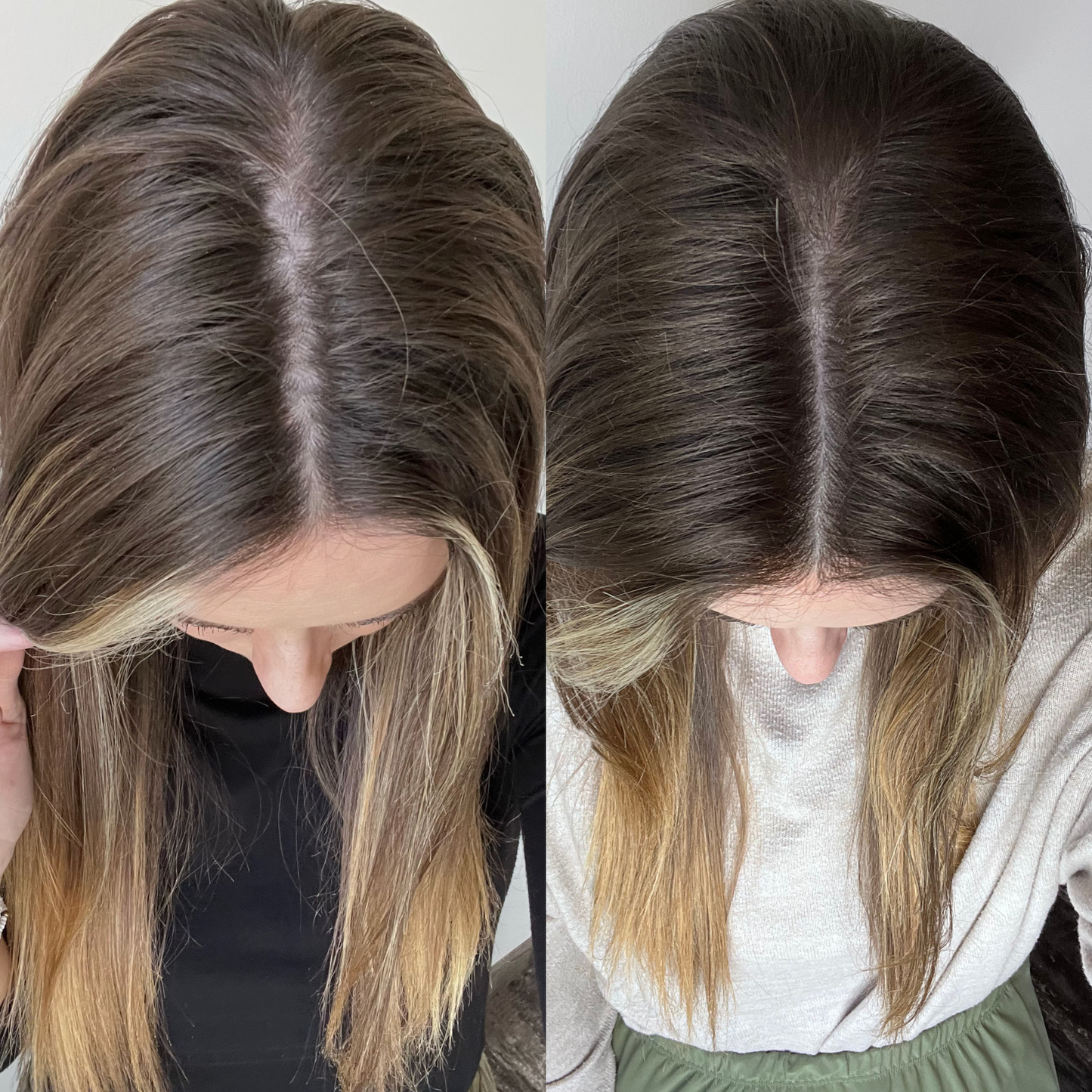
Pumpkin Seed Oil vs Saw Palmetto for Hair Loss: Which Works?

- Both ingredients work via the same 5-alpha-reductase pathway, but they have different evidence bases and safety profiles.
- Pumpkin seed oil has a dedicated randomised controlled trial in men and is widely considered well-tolerated in women.
- Saw palmetto carries hormonal cautions, especially relevant for women of reproductive age or those on HRT.
- For most UK women, a high-quality pumpkin seed oil softgel is the more cautious, evidence-aligned starting point.

If you're comparing pumpkin seed oil vs saw palmetto for hair loss, you're already asking the right question — both ingredients target the same hormonal pathway, but their evidence, safety considerations, and practical use differ in ways that genuinely matter for a woman deciding what to take.
In this guide
- How we evaluated these ingredients
- How both ingredients work: the DHT connection
- The evidence: what the research actually shows
- Head-to-head comparison table
- Why pumpkin seed oil is our recommended choice
- Saw palmetto: context, products, and honest caveats
- Limitations of the evidence
- Verdict: who should choose what
- Frequently asked questions
- Sources
Transparency note: this guide is published by Lumeyr. Our evaluation criteria are set out below and applied to all options including our own products. We flag where Lumeyr products rank and why, but we also acknowledge limitations and tell you when a different approach might suit you better.
How we evaluated these ingredients
To make this comparison genuinely useful rather than just persuasive, we assessed each ingredient — and the supplement products built around it — against five criteria:
- Ingredient evidence: Is there human clinical research, and how strong is it? (Randomised trials > observational studies > in-vitro data.)
- Dosage transparency: Does the product label state the exact amount per serving, or hide behind a proprietary blend?
- Format and bioavailability: Does the delivery format (softgel, capsule, liquid) match how the ingredient is best absorbed?
- Safety profile for women: Are there documented interactions, hormonal cautions, or contraindications relevant to women specifically?
- UK availability and value: Can you buy it easily in the UK, and is the cost per effective daily dose reasonable?
How both ingredients work: the DHT connection
Before comparing the two, it helps to understand why they are often mentioned together. Both pumpkin seed oil and saw palmetto are proposed to work — at least in part — by modulating the activity of 5-alpha-reductase (5-AR), the enzyme that converts testosterone into dihydrotestosterone (DHT). Elevated DHT activity at the scalp is associated with miniaturisation of hair follicles in androgenetic alopecia.
You can read more about this mechanism in our full guide to natural 5-alpha-reductase inhibitors, but the short version is: anything that supports normal 5-AR activity may help slow follicle miniaturisation, which is why these two ingredients are frequently compared.
The key difference is that pumpkin seed oil is thought to work primarily through its phytosterol content (beta-sitosterol in particular), alongside a fatty-acid profile rich in linoleic acid, whereas saw palmetto is believed to work via its liposterolic extract — fatty acids and sterols derived from the berry. Both target overlapping pathways, but through somewhat different chemical compositions.

The evidence: what the research actually shows
Pumpkin seed oil
The most frequently cited human study is a 24-week randomised, double-blind, placebo-controlled trial (Cho et al., 2014) involving men with mild-to-moderate androgenetic alopecia. Participants received 400 mg of pumpkin seed oil or a placebo daily. At 24 weeks, the pumpkin seed oil group showed a significantly greater increase in hair count compared with placebo. This remains the most robust standalone human trial on the ingredient to date.
It is important to note: this trial was conducted in men. Direct, equivalent RCT data in women with female-pattern hair loss is not yet available in the published literature. That said, the underlying mechanism — supporting normal 5-AR activity — is relevant to androgenetic hair thinning in women too, and pumpkin seed oil is widely regarded as having a favourable safety profile for women. If you'd like more detail on the female-specific angle, see our complete guide to pumpkin seed oil for women's hair growth.
Saw palmetto
Saw palmetto has a longer history of research, primarily in the context of benign prostatic hyperplasia (BPH) in men, which involves the same 5-AR pathway. For hair specifically, a small randomised trial (Prager et al., 2002) tested a topical formulation and reported some benefit in men with androgenetic alopecia, though the sample size was small. Oral saw palmetto research for hair loss is more limited.
For women, the picture is more complicated. Because saw palmetto has demonstrated anti-androgenic effects in some studies, healthcare professionals sometimes advise caution for women of reproductive age, those who are pregnant or breastfeeding, and those on hormonal therapies including HRT or combined oral contraceptives. The evidence base for saw palmetto's use in female-pattern hair loss specifically is thinner than proponents sometimes suggest.
Head-to-head comparison table
The table below summarises the key differences across our five evaluation criteria. For named UK supplement products, we have included only widely verifiable, generic facts — please check each brand's current label and price before purchasing, as these change.
| Criterion | Pumpkin Seed Oil (as ingredient) | Saw Palmetto (as ingredient) |
|---|---|---|
| Primary mechanism | Phytosterols (beta-sitosterol), linoleic acid; supports normal 5-AR activity | Liposterolic extract (fatty acids & sterols); supports normal 5-AR and androgen-receptor activity |
| Human clinical trial for hair | Yes — 1 RCT in men (Cho et al., 2014, 24 weeks, placebo-controlled) | Limited — small RCT (Prager et al., 2002, topical, men); oral hair-specific data is sparse |
| Evidence in women specifically | Mechanism plausible; no dedicated women's hair RCT published | Mechanism plausible; limited dedicated female-pattern hair loss RCT data; hormonal cautions apply |
| Safety considerations for women | Favourable profile; no significant hormonal interactions reported in the literature at typical supplement doses | Documented anti-androgenic effects; caution advised with HRT, OCP, pregnancy, breastfeeding |
| Typical supplement format (UK market) | Softgel (oil-filled) — suits fat-soluble absorption; also available in capsule blends | Capsule or standardised extract capsule; sometimes combined in multi-ingredient blends |
| Dosage transparency | Varies by brand; quality products state mg of cold-pressed oil per softgel clearly | Varies widely; standardisation (% fatty acids) not always declared on UK retail products |
| Typical UK cost per month | Approx. £10–£30 depending on dose and brand (check current listing) | Approx. £8–£25 depending on dose and brand (check current listing) |
| UK availability | Widely available — Amazon UK, Holland & Barrett, specialist supplement brands | Widely available — Amazon UK, Holland & Barrett, health food stores |
Why pumpkin seed oil is our recommended choice
When we apply our five criteria honestly, pumpkin seed oil comes out ahead for most UK women considering a DHT-support supplement for the first time — and the reasons are practical, not just commercial.
The Cho et al. 2014 RCT is not a perfect study — see the limitations section — but it remains the only dedicated, placebo-controlled human trial of a pumpkin seed oil supplement for hair count, and that distinction matters when you are spending money on a product for three to six months. Saw palmetto's hair-specific human evidence is comparatively thinner.
The safety profile is the other decisive factor. Women's hormonal contexts vary enormously — perimenopausal, post-menopausal, on contraception, on HRT, managing PCOS. Pumpkin seed oil does not carry the same documented hormonal interaction flags as saw palmetto, which makes it a more versatile starting option across different life stages. You can read more about the hormonal dimension of female hair thinning in our guide to androgenetic alopecia symptoms in women.
Our pick: Lumeyr Pumpkin Seed Oil Softgels
Lumeyr's Pumpkin Seed Oil Softgels are formulated as oil-filled softgels — the appropriate format for a fat-soluble ingredient — with a clearly declared dose per serving. The softgel format supports absorption in a way that a dry-powder capsule of pumpkin seed meal does not replicate, because the phytosterols and fatty acids in pumpkin seed oil are lipid-soluble compounds that benefit from an oil matrix for absorption.
The label declares the quantity of cold-pressed pumpkin seed oil per softgel, which means you can assess what you are getting — a basic standard that not all competitors meet. The product is manufactured to GMP standards and available with UK delivery without import delays or customs costs that can apply to US-sourced equivalents.
Price: see lumeyr.com — check the current listing for any subscription options.
- Pros: Oil-filled softgel for appropriate fat-soluble delivery; declared dose per serving; no documented hormonal interaction flags; made to GMP; UK-delivered.
- Honest con: Like all pumpkin seed oil supplements, the primary human RCT was conducted in men — women choosing this ingredient are extrapolating from that data. Results are typically not visible before 12–24 weeks of consistent use.
Try Lumeyr Pumpkin Seed Oil Softgels
Clearly dosed, oil-filled softgels formulated to support normal hair health. Made to GMP. UK delivery.
View Pumpkin Seed Oil Softgels →Saw palmetto: context, UK products, and honest caveats
Saw palmetto is not a bad ingredient — it has a long history of use and a plausible mechanism. For some women — particularly post-menopausal women not on HRT, who have discussed the option with their GP — it may be a reasonable addition to a hair-support routine. The context and cautions simply require more careful thought than pumpkin seed oil typically does.
If you are considering saw palmetto specifically, the key things to look for in a UK product are: a standardised extract (look for % total fatty acids declared, typically 85–95%), a clear per-capsule dose, and third-party testing. Typical standalone saw palmetto supplements available at Holland & Barrett and on Amazon UK vary considerably in their standardisation and dosing — always read the label and, if in doubt, ask a pharmacist.
One approach that avoids the either/or dilemma is a broader hair-support supplement that combines pumpkin seed oil with complementary ingredients (biotin, zinc, marine collagen) without relying on saw palmetto at all. Lumeyr's Lumeyr Women formulation takes this approach — it pairs key hair-support nutrients without the hormonal caution flags associated with saw palmetto. For a fuller overview of multi-ingredient options, see our 2026 comparison of anti-hair-loss supplement brands for women.

Limitations of the evidence
Honest evaluation requires acknowledging what the research does not yet show clearly. There are several genuine limitations to be aware of before choosing either ingredient:
- The key pumpkin seed oil RCT was small and male-only. The Cho et al. 2014 trial enrolled 76 men. There is no equivalent placebo-controlled trial published in women. Extrapolating from male androgenetic alopecia to female-pattern hair thinning involves assumptions about shared mechanisms that are plausible but not confirmed.
- Saw palmetto hair trials are few and small. The most cited hair-specific trials involved fewer than 100 participants and used topical or combination formulations, making it difficult to isolate the oral ingredient's contribution.
- Most positive studies were industry-funded or had limited follow-up. Neither ingredient has large, long-term, independently funded RCTs with validated hair-count outcomes in women. That does not mean they are ineffective — it means the evidence base is still developing.
- Supplements address one pathway. Female hair thinning is multifactorial: nutritional deficiencies (iron, ferritin, vitamin D, zinc), thyroid function, stress (cortisol), and scalp health all play roles. A single ingredient will not address all contributors. Our guide on stress-related hair loss covers the cortisol angle in detail.
- Results take time. The hair growth cycle means meaningful changes in density are rarely visible before 3–6 months of consistent supplementation. Anyone expecting faster results should adjust expectations.
Verdict: who should choose what
For most UK women experiencing gradual hair thinning consistent with androgenetic alopecia or age-related density changes, pumpkin seed oil softgels represent the more straightforward, better-evidenced, and safer starting choice compared with saw palmetto. The single published RCT, the favourable safety profile for women across different hormonal contexts, and the oil-matrix format that supports fat-soluble absorption all point in the same direction.
Saw palmetto is not without merit, and for post-menopausal women not on hormonal therapy who have discussed it with their GP, it remains a plausible option. But given the stronger safety cautions and thinner hair-specific evidence base, it should not be the default first choice for women — particularly those of reproductive age, on hormonal contraception, or on HRT.
Pumpkin seed oil may NOT be the right sole approach if:
- Your hair loss is sudden or patchy — see a GP first.
- You have significant nutritional deficiencies (low ferritin, vitamin D) — those need addressing directly.
- You are looking for a licensed medical treatment — neither ingredient is one; finasteride and minoxidil remain the only MHRA-licensed hair-loss medications in the UK.
- You want a broader multi-nutrient approach — in that case, consider Lumeyr Women or our full range of hair growth supplements alongside the softgels.
Ready to start with pumpkin seed oil?
Lumeyr's clearly dosed softgels are formulated in an oil matrix for appropriate fat-soluble absorption. UK delivery. No import delays.
Shop Pumpkin Seed Oil Softgels →Frequently asked questions
Can women take pumpkin seed oil for hair loss?
Yes, pumpkin seed oil is widely considered safe for women at typical supplement doses and does not carry the hormonal interaction warnings associated with saw palmetto. The primary clinical trial was conducted in men, so women are extrapolating from that evidence base, but the ingredient's safety profile and 5-AR-supporting mechanism are considered relevant to female androgenetic hair thinning. If you are pregnant, breastfeeding, or have a medical condition, check with your GP first.
How long does pumpkin seed oil take to work for hair?
Most users should not expect visible changes in hair density before 12–24 weeks of consistent daily use, because the hair growth cycle (anagen, catagen, telogen) takes months to complete. The Cho et al. 2014 trial ran for 24 weeks. Setting a realistic timeframe of three to six months before assessing results is important to avoid abandoning a supplement too soon.
Is saw palmetto safe for women to take?
Saw palmetto is not recommended for women who are pregnant or breastfeeding, and caution is advised for women on hormonal medications including the oral contraceptive pill or HRT, due to documented anti-androgenic effects. Post-menopausal women not on hormonal therapy may be better placed to consider it, but should still discuss it with their GP before starting, particularly if they take other medications.
How much do Lumeyr Pumpkin Seed Oil Softgels cost, and is there a subscription?
The current price is shown on the product page at lumeyr.com/products/pumpkin-seed-oil-softgels-1 in your local currency — prices update with Lumeyr's current pricing. Check the listing for any available subscription or bundle discount, as these change periodically. UK delivery is standard.
Can I take pumpkin seed oil and saw palmetto together?
Taking both ingredients together is something some multi-ingredient supplements do, but the combined safety and efficacy in women has not been tested in clinical trials. If you are considering a dual approach, review the individual safety notes for each ingredient as they apply to your health profile, and speak to a pharmacist or GP — particularly if you take any hormonal medications.
What is the difference between pumpkin seed oil softgels and a pumpkin seed oil capsule?
A softgel contains liquid oil directly, which is the appropriate format for a fat-soluble ingredient — phytosterols and fatty acids dissolve in fats, not water, so an oil matrix supports absorption. A hard capsule filled with dried or powdered pumpkin seed meal is a different product: the fatty-acid and phytosterol content may be lower, and the absorption dynamics are different. Look for cold-pressed pumpkin seed oil in a softgel (gelatin or vegetarian) when choosing a supplement for hair support.
Sources
- Cho YH et al. (2014) — Effect of pumpkin seed oil on hair growth in men with androgenetic alopecia: a randomised, double-blind, placebo-controlled trial. Evidence-Based Complementary and Alternative Medicine. PMID 24864154.
- Prager N et al. (2002) — A randomised, double-blind, placebo-controlled trial to determine the effectiveness of botanically derived inhibitors of 5-alpha-reductase in the treatment of androgenetic alopecia. Journal of Alternative and Complementary Medicine. PMID 12006122.
- Strauch G et al. (1994) — Comparison of finasteride (Proscar) and Serenoa repens (Permixon) in the inhibition of 5-alpha reductase in healthy male volunteers. European Urology. PMID 9521603.
- Melnik BC (2015) — Linking diet to acne metabolomics, inflammation, and comedogenesis: an update. Clinical, Cosmetic and Investigational Dermatology. (Context: beta-sitosterol and androgen signalling.) PMID 28416887.
This article is published by Lumeyr. It is intended as general information only and does not constitute medical advice. If you are concerned about hair loss, please speak to your GP or a qualified healthcare professional. Supplements support normal physiological function — they do not treat, cure or prevent any medical condition.

Patricia writes about the connection between stress, sleep and hair health. She is interested in how what happens in our heads — poor sleep, chronic cortisol, anxiety — ends up showing in our hair, and how to address it holistically.
View author profile →
This article follows our editorial & research standards. It is informational content, not medical advice.