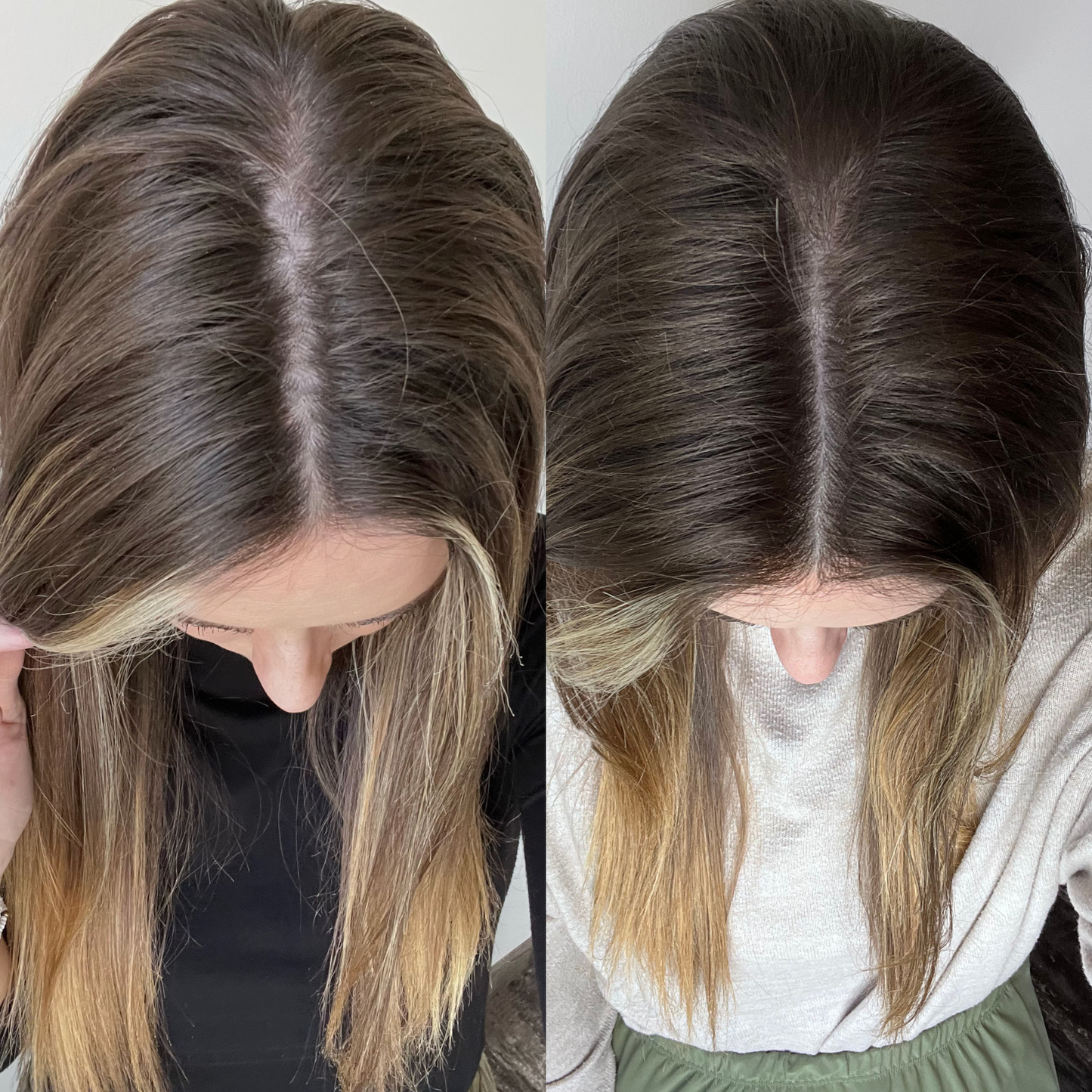
Pumpkin Oil and DHT: What the Evidence Says for Women

- Pumpkin seed oil contains phytosterols that may inhibit the enzyme (5-alpha reductase) that converts testosterone into DHT — the hormone linked to hair miniaturisation.
- The most-cited human trial (Cho et al., 2014) involved men; female-specific data remains limited.
- Pumpkin seed oil is best used as part of a broader approach, not as a standalone DHT blocker.
- Consistency over at least three to six months is considered necessary before results become apparent.

Pumpkin seed oil and DHT have become an increasingly searched pairing among women noticing diffuse thinning or a widening part — but the science behind the connection is more nuanced than supplement marketing often suggests. Here is what the evidence actually shows, and how to use this ingredient sensibly.
In this article
What is DHT and why does it matter for hair?
Dihydrotestosterone (DHT) is an androgen — a hormone derived from testosterone through the action of an enzyme called 5-alpha reductase (5-AR). Both men and women produce DHT, though women generally have lower circulating levels. The problem arises when hair follicles that are genetically sensitive to DHT are exposed to it repeatedly: the follicle progressively miniaturises, producing finer and shorter strands until it may stop producing visible hair altogether. This process is called androgenetic alopecia, and in women it typically presents as diffuse thinning across the crown rather than the receding hairline seen in men.
DHT acts by binding to androgen receptors in the dermal papilla — the cluster of cells at the base of each follicle that controls the hair growth cycle. When DHT binds to these receptors, it shortens the anagen (growth) phase and prolongs the telogen (resting) phase, meaning follicles spend more time dormant and less time actively producing hair. For women, hormonal fluctuations around perimenopause, post-partum periods, or stopping hormonal contraception can all tip the balance towards greater androgenic sensitivity. If you would like a deeper dive into the hormonal side, our guide to DHT and female hair loss covers the full picture.
How pumpkin seed oil may influence DHT
Pumpkin seed oil — cold-pressed from the seeds of Cucurbita pepo — is rich in phytosterols, particularly beta-sitosterol and delta-7-sterine. Phytosterols are plant-derived compounds with a molecular shape similar to cholesterol, and this structural similarity is thought to underlie their interaction with steroid-processing enzymes, including 5-alpha reductase. By competing at the enzymatic binding site, phytosterols may reduce the rate at which testosterone is converted to DHT — a mechanism sometimes described as competitive inhibition.
Pumpkin seed oil also contains meaningful quantities of zinc, tocopherols (vitamin E), and linoleic acid. Zinc independently plays a role in 5-AR regulation, and a deficiency in zinc is widely associated with increased hair shedding. This means pumpkin seed oil may support hair health through more than one pathway simultaneously: partial DHT suppression via phytosterols, antioxidant protection of follicle cells via tocopherols, and mineral support via zinc.
It is worth noting that pumpkin seed oil is not a pharmaceutical-grade 5-AR inhibitor in the way that finasteride or dutasteride are. Those drugs were designed specifically to block 5-AR and do so with much greater potency. Pumpkin seed oil works more gently and through a combination of mechanisms — which is both its limitation and, for many women, its appeal.

What the human evidence actually shows
The most frequently cited clinical study on pumpkin seed oil and hair loss is a randomised, double-blind, placebo-controlled trial by Cho et al. (2014), published in Evidence-Based Complementary and Alternative Medicine. Over 24 weeks, participants who received 400 mg of pumpkin seed oil daily showed a mean hair count increase of approximately 40% compared to the placebo group. Urinary DHT measurements in the treatment group also shifted in a direction consistent with reduced 5-AR activity. This is the study that has done the most to establish pumpkin seed oil's credibility as a DHT-modulating ingredient.
However, there is a significant caveat: the Cho et al. trial enrolled men with mild to moderate androgenetic alopecia. There are currently no large-scale, peer-reviewed, placebo-controlled trials that replicate these findings specifically in women. Smaller observational data and formulation studies support the biological plausibility, and some researchers studying phytosterols more broadly have noted that beta-sitosterol in particular demonstrates measurable 5-AR inhibitory activity in laboratory settings — but translating that to a confirmed clinical outcome in women requires more rigorous investigation.
Pumpkin seed oil is also commonly studied alongside saw palmetto, another phytosterol-rich ingredient with a similar proposed mechanism. Our comparison article on pumpkin seed oil vs saw palmetto for hair loss explores how these two ingredients differ and whether combining them makes sense. In formulations where both appear, the evidence base is somewhat broader, though still largely male-centric.
| Mechanism | Compound responsible | Strength of evidence |
|---|---|---|
| 5-alpha reductase inhibition (competitive) | Beta-sitosterol, delta-7-sterine | Moderate — human RCT in men; lab data broadly supportive |
| Antioxidant protection of follicle cells | Tocopherols (vitamin E forms) | Good — well-established antioxidant mechanism |
| Zinc co-factor support for 5-AR regulation | Zinc | Good — zinc deficiency clearly associated with shedding |
| Anti-inflammatory effect on scalp | Linoleic acid, phytosterols | Preliminary — mainly in vitro and animal data |
Limitations of the evidence
Honesty about gaps in the research is important here. The Cho et al. (2014) trial is a genuinely well-designed study, but it had a relatively small sample size and enrolled only male participants. Extrapolating its results to women — who have different hormonal environments, different relative androgen levels, and different patterns of androgenetic alopecia — involves an assumption that the science does not yet fully support.
There is also the question of dose and form. Most of the phytosterol research uses specific standardised extracts at controlled doses; many food-grade pumpkin seed oils available at supermarkets are not standardised and may contain variable phytosterol concentrations depending on origin, processing temperature, and storage conditions. A cold-pressed, dark-bottled oil will retain more of its active compounds than a refined version, but even then the dose delivered per teaspoon varies considerably.
Additionally, many studies on pumpkin seed oil use it within multi-ingredient formulations — combined with saw palmetto, zinc, or other botanicals. This makes it difficult to isolate pumpkin seed oil's individual contribution to any observed improvement. The honest position is: the mechanistic case is plausible, the early human data is encouraging, but definitive, women-specific, large-scale replication is still needed.
How to use pumpkin seed oil for hair health
Oral supplementation
The most evidence-backed route is oral supplementation. The dose used in the Cho et al. trial was 400 mg per day, delivered as standardised softgels. Lumeyr's Pumpkin Seed Oil Softgels are formulated as a convenient daily capsule option for those wanting to add this ingredient specifically. When taken orally, phytosterols must first be absorbed through the gut and then reach the systemic circulation — fat-soluble compounds like these are better absorbed when taken with a meal containing some dietary fat.
Topical application
Pumpkin seed oil can also be applied directly to the scalp. Some users mix a small amount into a carrier oil and massage it into the scalp before washing. The evidence for topical efficacy is currently weaker than for oral use — it is unclear how effectively phytosterols penetrate the scalp barrier and reach dermal papilla cells. That said, the oil's linoleic acid content may support the scalp's barrier function and reduce local inflammation, which is a reasonable supplementary goal. Pairing topical application with a weekly Revive + Restore Scalp Scrub can help ensure the scalp surface is clear of build-up before any oil treatment.
Timing and patience
Hair growth cycles mean that any intervention needs a minimum of 12 to 16 weeks before visible changes are likely — and three to six months is a more realistic window for meaningful assessment. Many users who discontinue before this point conclude the ingredient is ineffective when, in fact, they simply have not yet cleared a full growth cycle. Commit to a consistent daily routine and photograph the crown in consistent lighting monthly so you have an objective reference point over time.

Beyond the oil: a whole-system approach
For women dealing with DHT-related thinning, pumpkin seed oil is best understood as one component within a broader strategy rather than a standalone solution. The research on hair loss in women consistently points to the importance of nutritional adequacy — particularly iron, ferritin, vitamin D, zinc, and B vitamins — alongside hormonal management and scalp health. Addressing only the DHT pathway while remaining deficient in key micronutrients will limit any results you see.
This is precisely why Lumeyr Women was formulated as a comprehensive supplement rather than a single-ingredient product. It combines pumpkin seed oil with a broader matrix of nutrients specifically selected for women's hair health needs — recognising that DHT is rarely the only driver, particularly for women in perimenopause, post-partum, or periods of high stress. You can explore how comprehensive formulations stack up in our guide to the best hair growth supplements for women in the UK.
Scalp circulation also deserves attention. Miniaturised follicles are often found in areas with reduced micro-circulation, and gentle mechanical stimulation — via massage or a scalp tool — can support blood flow to the dermal papilla. Our scalp care range is designed to complement an internal supplement routine with external follicle-supportive habits. The relationship between stress and hair loss is another dimension worth considering: chronically elevated cortisol can impair the hair growth cycle independently of DHT, which is why a genuinely holistic approach considers both the hormonal and the nervous system dimension.
Support your follicles from the inside out
Lumeyr Women combines pumpkin seed oil with the micronutrients women's hair health research consistently flags — designed for a three-to-six month committed programme.
See Lumeyr Women →Frequently asked questions
Does pumpkin seed oil block DHT?
Pumpkin seed oil contains phytosterols — principally beta-sitosterol — that may competitively inhibit 5-alpha reductase, the enzyme that converts testosterone into DHT. This is not a pharmaceutical-grade block; it is a gentler, partial inhibition. The most cited human trial (Cho et al., 2014) found changes in urinary DHT consistent with reduced 5-AR activity over 24 weeks, though participants were men. Women-specific data is still limited.
How much pumpkin seed oil should I take for hair loss?
The dose used in the primary human clinical trial was 400 mg of standardised pumpkin seed oil daily, taken orally. This is the most evidence-referenced dose and is what most reputable hair health supplements aim to match. Always take it with food containing fat to maximise phytosterol absorption, and allow at least 12 to 16 weeks before evaluating any change.
Can women use pumpkin seed oil for DHT-related hair thinning?
Yes, women can use pumpkin seed oil as part of a hair health routine, though it is important to acknowledge that the clinical evidence comes primarily from male subjects. The phytosterol and zinc content of the oil is mechanistically relevant to female androgenetic alopecia, and many trichology practitioners include it in multi-ingredient recommendations for women experiencing DHT-sensitive thinning. It works best alongside adequate micronutrient intake and scalp health practices.
How long does pumpkin seed oil take to work for hair?
Based on the available trial data, a minimum of 24 weeks — roughly six months — is a realistic timeframe for assessing meaningful change. Hair grows approximately 1–1.5 cm per month, and the growth cycle means new follicle activity from any intervention takes several months to become visible at the scalp surface. Many practitioners recommend photographing the crown monthly under consistent lighting to track progress objectively.
Is topical pumpkin seed oil effective for DHT?
Topical pumpkin seed oil has not been studied as rigorously as oral supplementation for DHT modulation. It may support scalp barrier function and reduce localised inflammation through its linoleic acid content, but whether topically applied phytosterols penetrate to the depth of the dermal papilla in sufficient quantities to inhibit 5-AR is not established by current evidence. Oral supplementation remains the better-supported route for the DHT-related mechanism.
Can pumpkin seed oil cause any side effects?
Pumpkin seed oil is generally well tolerated at doses used in clinical trials. Some individuals report mild gastrointestinal discomfort — typically loose stools or nausea — particularly when starting at higher doses. Taking the supplement with food significantly reduces this risk. Pumpkin seed oil is not known to interact with common medications, but if you are taking hormonal medications or pharmaceuticals for hair loss, consult your GP before adding any new supplement.

Conclusion
Pumpkin seed oil is a genuinely interesting ingredient in the context of DHT-related hair thinning — not because it acts like a pharmaceutical, but because its phytosterol and mineral content supports multiple relevant pathways simultaneously. The human evidence, while limited to male subjects in its most robust form, provides a mechanistic and clinical foundation that justifies its inclusion in a comprehensive hair health strategy for women. The key is using it consistently, at a meaningful dose, alongside broader nutritional and scalp support rather than expecting it to work in isolation.
If you are exploring supplement options, Lumeyr Women offers a considered multi-ingredient approach, or you can add Lumeyr's standalone Pumpkin Seed Oil Softgels to your existing routine. For context on how all the key hair health nutrients fit together, the complete guide to hair nutrition is a useful companion read.
Sources
- Cho et al. (2014) — Effect of pumpkin seed oil on hair growth in men with androgenetic alopecia: a randomised, double-blind, placebo-controlled trial. Evidence-Based Complementary and Alternative Medicine.
- Panahi et al. (2015) — Rosemary oil vs minoxidil 2% for the treatment of androgenetic alopecia: a randomised comparative trial. Skinmed.
- Stamatiadis et al. (1988) — Inhibition of 5-alpha-reductase activity in human skin by zinc and azelaic acid. British Journal of Dermatology.
This article follows our editorial & research standards. It is informational content, not medical advice.