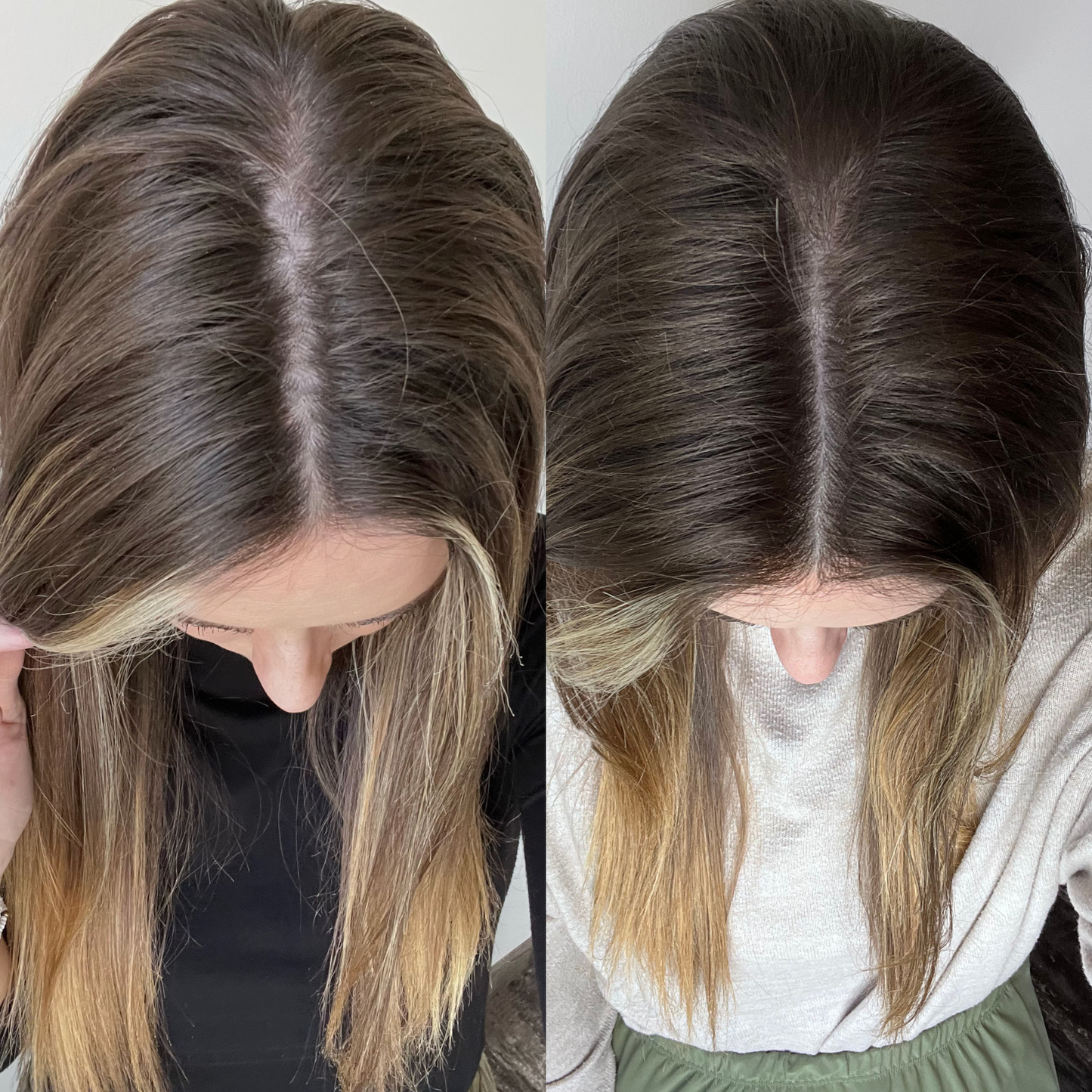
Rosemary Oil for Hair Growth: What the Evidence Actually Says


Rosemary oil hair growth evidence in the UK has never been more searched — and for good reason. Women are looking for honest answers beyond the hype: does it actually work, how do you use it properly, and where does it fit alongside other proven approaches?
What Rosemary Oil Actually Is
Rosemary oil — properly called Rosmarinus officinalis essential oil — is a concentrated volatile extract steam-distilled from the flowering tops and leaves of the rosemary plant. It is not the same as rosemary-infused carrier oil, and that distinction matters enormously when you are trying to evaluate evidence or buy a product that will actually do something.
The key active compound most researchers focus on is rosmarinic acid, alongside 1,8-cineole (also called eucalyptol), camphor, and a range of antioxidant polyphenols. These compounds collectively give rosemary oil its anti-inflammatory, antimicrobial, and circulation-stimulating properties — all of which are relevant to scalp health and the hair growth cycle.
In the UK, rosemary essential oil is widely available in health shops, pharmacies, and online. Prices vary from a few pounds for a small bottle of unknown provenance to considerably more for third-party tested, high-olfactory-grade products. For scalp use, quality and dilution both matter.
What the Research Genuinely Shows
The most-cited piece of evidence comparing rosemary oil to minoxidil 2% comes from a small randomised controlled trial — the kind of study that generates headlines but deserves careful reading. The trial ran over roughly six months and found that participants using a rosemary oil preparation showed hair count increases broadly comparable to those using minoxidil, with notably fewer scalp-itch side effects. Sample sizes were modest, and neither the journal nor the specific figures should be reported as definitive proof of equivalence — but the signal is genuinely interesting.
A second area of evidence involves rosemary's inhibition of 5-alpha-reductase, the enzyme that converts testosterone into DHT (dihydrotestosterone). DHT is a key driver of androgenetic alopecia — what most people call female or male pattern hair loss. In laboratory and some animal model studies, rosmarinic acid has demonstrated meaningful 5-alpha-reductase inhibitory activity. Whether that translates directly to clinical hair retention in women at real-world topical doses is still being investigated.
There is also a reasonable body of in-vitro research showing rosemary oil promotes proliferation of dermal papilla cells — the specialised cells at the base of each follicle that regulate the anagen (growth) phase of the hair cycle. Dermal papilla cell activation is one of the primary mechanisms by which minoxidil is believed to work, so rosemary's performance in this area is scientifically plausible, not merely anecdotal.
To summarise the state of the evidence fairly: rosemary oil has more credible scientific support than most botanical hair ingredients, but the clinical evidence base is still small compared to licensed treatments such as minoxidil or finasteride. It is a well-supported adjunct, not a guaranteed cure.

How Rosemary Oil May Support Hair Growth
There are three plausible mechanisms, and understanding them helps you use rosemary oil strategically rather than just hopefully.
1. Microcirculation stimulation
Rosemary oil has a well-established rubefacient effect — it gently stimulates blood flow to the area where it is applied. Hair follicles are metabolically demanding structures; they rely on a rich blood supply to deliver oxygen and nutrients during the anagen phase. Poor scalp circulation is not the primary cause of most hair loss, but anything that improves nutrient delivery to follicles is likely to support rather than harm growth conditions.
2. DHT inhibition at the follicle level
As noted above, rosmarinic acid shows 5-alpha-reductase inhibitory activity. For women experiencing androgenetic alopecia, where DHT sensitivity causes follicle miniaturisation over time, reducing local DHT activity at the scalp could theoretically slow that process. This is also the mechanism behind natural 5-alpha-reductase inhibitors more broadly.
3. Anti-inflammatory and antioxidant action
Chronic low-grade scalp inflammation is increasingly recognised as a contributor to diffuse hair thinning. Rosemary oil's polyphenol content may help dampen that inflammatory environment, supporting healthier follicle cycling. Oxidative stress at the follicle level is also implicated in premature hair ageing — antioxidant plant compounds offer some theoretical protection here.
How to Use It Correctly — A UK Scalp Routine
The gap between rosemary oil that works and rosemary oil that does nothing is almost always in the application. Here is a straightforward protocol based on what the research populations actually did.
| Step | What to do | Why it matters |
|---|---|---|
| Dilute properly | 2–3 drops of rosemary essential oil per teaspoon (5 ml) of a carrier oil such as jojoba or sweet almond | Undiluted essential oil can cause contact dermatitis; proper dilution ensures safe, sustained skin contact |
| Apply to dry or damp scalp | Section the hair and apply directly to the scalp with fingertips or a dropper | Wet hair dilutes the oil further and reduces contact time with the scalp |
| Massage for 2–4 minutes | Use firm circular movements across the whole scalp | Massage itself stimulates circulation and may extend follicle time in the anagen phase — a synergistic benefit |
| Leave on for at least 30 minutes | Leave on overnight for best results, or at minimum 30 minutes before washing | Contact time is essential for absorption of active compounds through the skin |
| Frequency | 2–3 times per week consistently | Trials that showed positive results used consistent, repeated application over months — not occasional use |
| Wash thoroughly | Shampoo twice if needed to remove carrier oil residue | Buildup on the scalp can clog follicles, counteracting any benefit |
If you find the pre-wash oil routine difficult to maintain, some women have success adding two to three drops of rosemary essential oil directly to their regular conditioner or a dedicated scalp serum. This reduces dwell time but can make consistency easier — and consistency is genuinely more important than the perfect protocol done sporadically.
For those in the UK dealing with hard water, it is worth knowing that limescale mineral deposits can affect how well anything absorbs into the scalp. Our guide on hard water and hair quality in the UK covers this in detail. A filtered showerhead is one of the simplest ways to remove that barrier from your routine.
Honest Limitations You Should Know
Rosemary oil is not a standalone solution for significant hair loss. If your hair thinning has a systemic cause — such as iron deficiency, thyroid dysfunction, postpartum hormonal shifts, or stress-related telogen effluvium — a topical oil will not address the root driver. It may support your scalp environment, but the underlying issue still needs attention.
The evidence base, while promising, is also limited by small sample sizes, short follow-up periods, and the difficulty of blinding participants in studies involving strongly scented substances. Larger, independent, longer-term trials are still needed before rosemary oil can be compared fairly to licensed pharmacological treatments. Women experiencing female pattern hair loss in particular should view rosemary oil as a complementary measure rather than a first-line treatment.
There is also a quality problem in the UK market. Many products labelled “rosemary oil” are either heavily diluted, adulterated with synthetic compounds, or made from rosemary infused in a carrier rather than true distilled essential oil. If you are using a product without a clear GC/MS (gas chromatography) certificate or from a brand that does not disclose its source, you may not be getting what the research used.

Beyond Rosemary: Building a Complete Approach
One of the most consistent findings across hair loss research is that single-ingredient approaches rarely produce dramatic results. Hair growth depends on a complex web of hormonal balance, nutrition, circulation, inflammation levels, and scalp microbiome health. Rosemary oil can contribute meaningfully to one or two of those factors. A complete routine addresses all of them.
Nutritionally, follicles are among the most nutrient-hungry cells in the body. Deficiencies in biotin, iron, zinc, vitamin D, and key amino acids are all associated with increased shedding. If you are not getting adequate levels through diet alone — which many UK women are not, particularly during winter months or times of high stress — a targeted supplement fills the gap that no topical oil can. Lumeyr Women is formulated specifically for this: a daily shot combining the micronutrients and botanical actives most commonly implicated in female hair thinning, in bioavailable forms and at meaningful doses.
Physically, scalp health matters as much as what you put on it. Buildup, excess sebum, and dead skin can all impede follicle function. A weekly scalp exfoliation — such as using the Revive + Restore Scalp Scrub — clears the follicle opening, improves product absorption, and supports a healthier scalp environment for everything else to work in. Pair this with regular massage using the JUMBO Scalp Stimulator to maximise microcirculation benefits beyond what your fingers alone can achieve.
For a broader look at how nutrition and supplementation interact with hair loss in women, our guide to female hair loss causes and treatments is a good next read.
Ready to Support Your Hair From the Inside Out?
Lumeyr Women combines clinically relevant ingredients in one daily shot — designed for busy women who want results, not just a longer bathroom shelf.
Explore Lumeyr Women →Whilst rosemary oil shows promise in topical applications, those seeking comprehensive hair support might also consider exploring whether liquid hair supplements or tablets offer superior benefits.
Frequently Asked Questions
How long does rosemary oil take to show results for hair growth?
Most research protocols run for a minimum of three to six months before statistically meaningful changes in hair count become measurable. Visible improvements in hair density and reduced shedding are typically reported around the three-month mark by consistent users. There is no reliable shortcut — sporadic use is unlikely to produce results comparable to what trials observed with consistent twice or thrice-weekly application.
Can I use rosemary oil if I have a sensitive scalp?
Yes, with care. Ensure the dilution is correct — no more than a 2% concentration in a carrier oil is appropriate for sensitive skin (roughly two drops per teaspoon of carrier). Perform a patch test on your inner forearm 24 hours before applying to the scalp. If you experience redness, itching, or a burning sensation, discontinue use. Camphor and 1,8-cineole, both present in rosemary oil, can be irritating at higher concentrations.
Is rosemary oil as effective as minoxidil for women in the UK?
The most frequently cited trial found comparable hair count results between rosemary oil and 2% minoxidil over six months, with fewer scalp side effects in the rosemary group. However, this was a single small trial, and 2% minoxidil is the lower-strength formulation. Five percent minoxidil, which is also available to women in the UK, has not been directly compared to rosemary oil in published trials. It is reasonable to view rosemary oil as a credible alternative or complement to lower-strength minoxidil, particularly for women who want a non-pharmaceutical approach, but it should not be assumed equivalent to higher-strength licensed treatments without further evidence.
Do I need to use a carrier oil, or can I add rosemary essential oil to my shampoo?
Both methods can work, but they have different characteristics. Diluting in a carrier oil gives the longest scalp contact time and the best absorption, which more closely mirrors what research studies used. Adding drops to shampoo is convenient but results in very brief contact with the scalp before rinsing — possibly insufficient for meaningful absorption. Adding to a leave-in conditioner or scalp serum is a practical middle ground that many women find sustainable long-term.
Can rosemary oil help with postpartum hair loss?
Postpartum hair loss (telogen effluvium) is driven primarily by the hormonal shift following delivery, not by follicle damage. Rosemary oil cannot reverse that hormonal trigger, but supporting scalp circulation and inflammation levels during the regrowth phase is unlikely to hurt. Most postpartum shedding resolves naturally within six to twelve months. Focusing on nutritional repletion — particularly iron and B vitamins — is more directly relevant to recovery speed than any topical treatment.
Should I use rosemary oil differently if I have hard water at home?
Potentially yes. Hard water mineral deposits (calcium and magnesium carbonates) build up on the scalp and can create a physical barrier that reduces absorption of any topical treatment. If you live in a hard water area — much of the South East of England, the Midlands, and East Anglia — filtering your shower water and incorporating regular scalp exfoliation before applying rosemary oil will improve how well it penetrates. Our full guide on hard water and hair quality in the UK covers this in detail.
Conclusion
Rosemary oil sits in an interesting position in the hair growth evidence landscape: it has more credible scientific support than almost any other botanical alternative, yet it remains limited by a small research base compared to licensed pharmaceutical treatments. For UK women looking for a well-reasoned, low-risk addition to a scalp routine — particularly those dealing with mild to moderate thinning, or who prefer to start with natural approaches — consistent, correctly diluted rosemary oil application is a genuinely worthwhile step. The key word is consistent. Combine it with proper internal nutrition from a targeted supplement like Lumeyr Women, maintain scalp hygiene with regular exfoliation, and address any underlying systemic causes, and you have a routine that gives every follicle the best possible environment in which to thrive.

Sofía writes about routines that genuinely fit a busy woman's life. What she loves most about the Lumeyr blog is finding the balance between aspirational and doable — advice that works at home, not just in the photoshoot.
View author profile
This article follows our editorial & research standards. It is informational content, not medical advice.