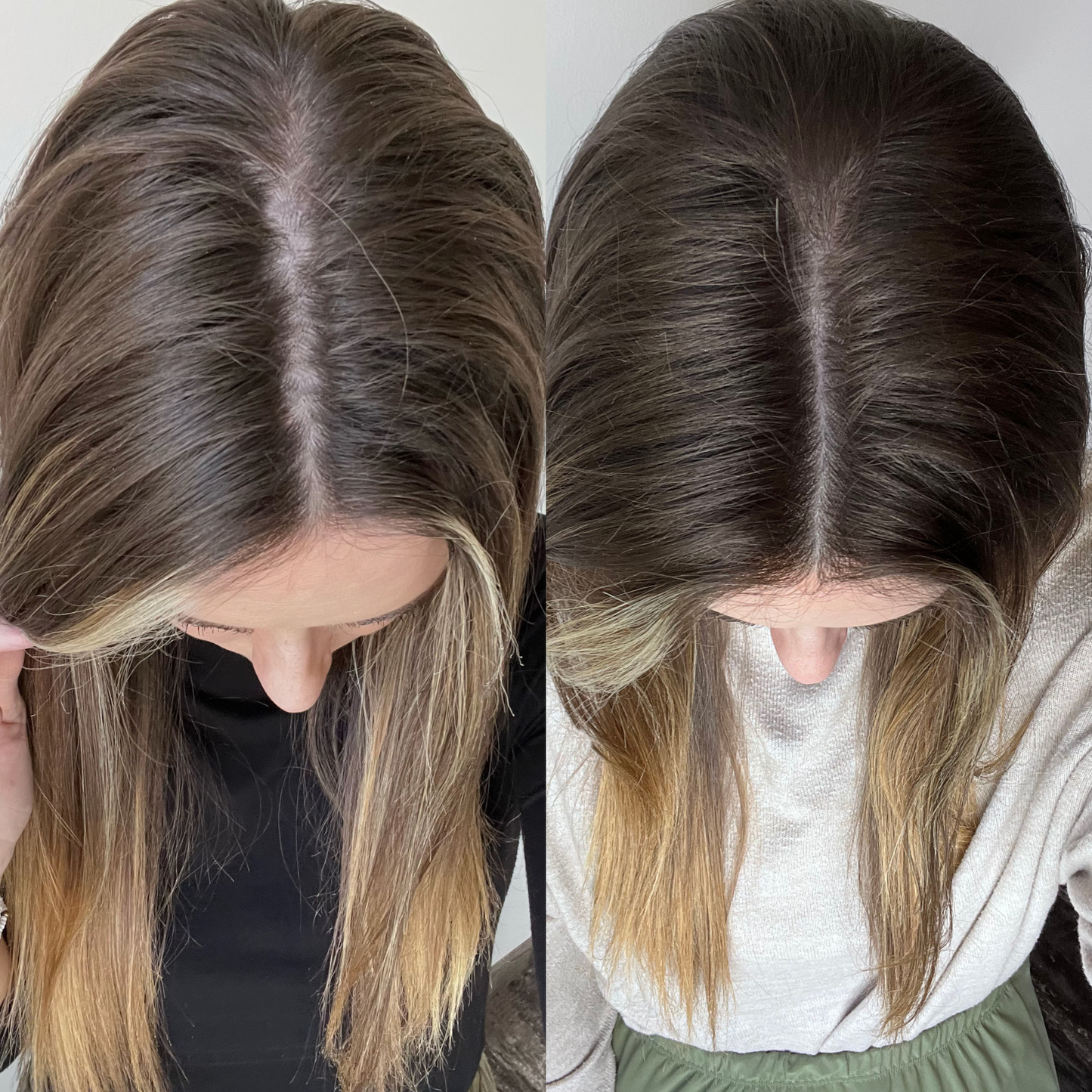
Rigevidon and Hair Loss: What's Really Happening

- Rigevidon is a combined oral contraceptive with a relatively high androgenic progestogen (levonorgestrel) that can trigger or worsen hair shedding in women who are genetically predisposed.
- Shedding usually peaks 2–4 months after starting or stopping the pill and typically falls within the telogen effluvium pattern.
- Switching to a lower-androgen pill (under GP guidance) and supporting the follicle environment with targeted nutrition can help recovery.
- Most women see improvement within 6–12 months once the hormonal trigger is addressed.

Rigevidon hair loss is one of the most-searched concerns among women on the combined pill in the UK — yet it is rarely flagged during a routine contraceptive appointment. If you have noticed more hair on your brush since starting or stopping Rigevidon, the hormonal mechanism is well understood, and there are practical steps you can take today.
In this article
What is Rigevidon and how does it affect hormones?
Rigevidon is a combined oral contraceptive containing 30 micrograms of ethinylestradiol and 150 micrograms of levonorgestrel. It is one of the most widely prescribed pills in the UK — available free of charge on the NHS — largely because it is low-cost and has a long safety record for pregnancy prevention. What makes it relevant to hair health is the specific progestogen it uses.
Levonorgestrel belongs to the second-generation class of progestogens and carries a relatively high androgenic index compared with newer progestogens such as drospirenone or desogestrel. In practice, this means it can bind, at least partially, to androgen receptors in the body. For the scalp, where androgen sensitivity governs the hair cycle, this matters more than it might in other tissues.
The oestrogen component (ethinylestradiol) exerts a counterbalancing effect by raising sex hormone-binding globulin (SHBG), which mops up free androgens in the bloodstream. While taking the pill, this partial offsetting means many women notice no hair change at all. The picture shifts, however, in women who already have an underlying sensitivity — a pre-existing tendency towards androgenetic hair loss, for instance — or when the pill is stopped and oestrogen levels fall sharply.
Why Rigevidon specifically can trigger hair loss

Not every combined pill carries the same hair-loss risk. The androgenic potency of the progestogen is the key differentiator. Published pharmacological profiles rank progestogens along a spectrum from strongly anti-androgenic (cyproterone acetate, drospirenone) to androgenically neutral (gestodene, desogestrel) to androgenically active (levonorgestrel, norethisterone). Rigevidon sits in the androgenically active group, which is why it appears more frequently in anecdotal reports and patient forum discussions about pill-related shedding.
The physiological pathway works like this: levonorgestrel can weakly stimulate androgen receptors in the dermal papilla cells at the base of each hair follicle. In a follicle that is already sensitive — owing to genetic polymorphisms in androgen receptor genes or elevated local DHT conversion — even a modest androgenic signal can shorten the anagen (growth) phase and push more hairs into telogen (resting), ultimately leading to shedding. Researchers studying contraceptive-related hair changes have documented this mechanism (Shapiro & Otberg, 2015 — overview in Dermatologic Clinics), though individual response varies considerably.
Family history is one of the strongest predictors. If your mother or grandmother noticed thinning along the central parting, your follicles are more likely to react to androgenic progestogens. Nutritional status — particularly iron, ferritin, zinc, and B vitamins — also influences how resilient the follicle is to any hormonal insult. A follicle that is already under nutritional stress needs a smaller hormonal trigger to shift into the resting phase prematurely.
Two distinct shedding patterns to know
Understanding which pattern applies to you shapes which solution makes sense. The two presentations are quite different in their timing and appearance.
Pattern 1 — Shedding while on Rigevidon
Some women begin losing hair within two to four months of starting the pill. This is consistent with telogen effluvium, a diffuse shedding process triggered by a systemic stressor — in this case, a hormonal shift. The body responds to the change in the hormonal environment by synchronising a larger-than-usual proportion of follicles into the resting phase simultaneously. Shedding typically presents as generalised thinning across the scalp rather than a defined bald patch. Hair on the pillow, in the shower drain, and on hairbrushes increases noticeably.
In women with underlying androgenetic alopecia, the pattern may also show some concentration along the central parting — a feature more typical of female pattern hair loss (FPHL). For a thorough overview of how these patterns are distinguished clinically, see our guide on androgenetic alopecia symptoms in women.
Pattern 2 — Shedding after stopping Rigevidon
This is perhaps the more common and more alarming presentation. When Rigevidon is discontinued, the oestrogen level drops quickly. Because oestrogen prolongs the anagen phase, a sudden fall causes a larger cohort of follicles to enter telogen simultaneously. The result — known as post-pill telogen effluvium — typically appears two to four months after the last pill, precisely because it takes that long for the follicles that entered telogen on the day of stopping to shed their hairs.
The reassuring point is that this pattern is self-limiting for most women. As the hormonal environment restabilises over the following months, the follicles return to their normal cycling. However, in women with a genetic predisposition, stopping the pill can unmask underlying FPHL that the pill’s oestrogen component had been partially suppressing. This is why some women feel their hair “never fully recovered” after discontinuing hormonal contraception.
| Pattern | Timing | Appearance | Likely cause | Usual outcome |
|---|---|---|---|---|
| Shedding on Rigevidon | 2–4 months after starting | Diffuse, generalised | Androgenic progestogen signal | May resolve or stabilise; consider pill switch |
| Post-pill shedding | 2–4 months after stopping | Diffuse; may concentrate at parting | Oestrogen withdrawal + unmasking of FPHL | Usually self-limiting; may take 6–12 months |
| Underlying FPHL unmasked | Ongoing after stopping | Widening parting, miniaturisation | Genetic androgenic sensitivity | Requires targeted long-term management |
What to do if Rigevidon is causing your hair loss
The practical response sits across three areas: medical review, nutritional support, and scalp environment. None of these replaces a conversation with your GP, but together they represent the most complete approach available to you.
Step 1 — Medical review and possible pill switch
Book a contraceptive review and specifically raise hair loss as a concern. Ask your GP or nurse about switching to a pill containing a lower-androgen or anti-androgenic progestogen. Options that are commonly discussed in this context include pills containing drospirenone or desogestrel, though individual suitability depends on your full medical history. The Faculty of Sexual and Reproductive Healthcare (FSRH) guidelines support discussing tolerability side effects — including hair changes — as a valid reason to review the prescription.
It is also worth asking for a blood panel that includes serum ferritin, full blood count, thyroid function (TSH), and, if appropriate, free androgen index. Low ferritin is one of the most overlooked contributors to hair shedding in women of reproductive age, and it can co-exist with pill-related shedding, compounding the effect.
Step 2 — Nutritional support for the follicle environment
Hair follicles are metabolically demanding structures. When the follicle is already under hormonal pressure, micronutrient sufficiency becomes especially important. Biotin, zinc, iron, selenium, vitamin D, and the B-vitamin complex all play documented roles in the hair growth cycle. Rather than piecing together individual supplements, a formulation designed specifically around women’s hair physiology is more practical for daily life.
Lumeyr Women is formulated as a daily shot containing a combination of ingredients relevant to hormonal hair health, including plant-based DHT modulators and key micronutrients. For women whose shedding is linked to androgenic activity — whether from a pill like Rigevidon or from underlying FPHL — addressing the follicle’s nutritional environment alongside any medical changes provides a more complete response. You can also explore our broader hair growth supplements collection to find the format that suits your routine.
If you are interested in the evidence base for individual ingredients, our detailed overview of female hair loss causes and treatments covers the mechanisms behind the most researched nutrients.
Step 3 — Scalp environment and circulation
A healthy scalp environment supports follicle recovery irrespective of the original trigger. Contraceptive-related hormonal shifts can alter sebum production and scalp sensitivity. Regular, gentle exfoliation removes product build-up and dead skin that can block follicle openings, while mechanical stimulation supports microcirculation to the dermal papilla.
The Revive + Restore Scalp Scrub is designed for this purpose — a weekly ritual that primes the scalp without stripping it. Used consistently alongside a targeted supplement, scalp care adds a meaningful layer to the recovery plan.

Support your follicles from the inside
Lumeyr Women is formulated for the hormonal realities of women’s hair — with ingredients that work with your cycle, not against it.
Explore Lumeyr Women →Limitations of the evidence
It would be dishonest to present the picture as more settled than it is. The specific relationship between levonorgestrel-containing pills and hair loss has not been studied in large, well-controlled randomised trials focusing on hair as a primary endpoint. Most of the evidence comes from case reports, retrospective patient surveys, and pharmacological inferences from androgen receptor binding studies. This means we cannot give precise percentages for how many Rigevidon users will experience meaningful shedding.
Individual variation is enormous. Many women take Rigevidon for years with no effect on their hair whatsoever. The women who experience shedding are most likely those with a pre-existing genetic vulnerability — but even this has not been confirmed in prospective studies large enough to draw firm conclusions.
Similarly, the evidence that switching to a lower-androgen pill definitively reverses hair loss is largely anecdotal and observational. It is plausible based on the mechanism, and it is a reasonable clinical decision, but it is not backed by a randomised trial. The same caveat applies to nutritional supplementation: ingredients such as biotin, zinc, and saw palmetto have individual studies supporting their relevance to hair biology, but clinical trials specifically in post-pill or contraceptive-related hair loss are absent.
This does not mean that action is pointless — quite the opposite. It means you should approach the evidence with appropriate expectations: measurable improvement is realistic over a 6–12 month window, but dramatic reversal within weeks is not. If you would like to explore the broader evidence landscape for supplement ingredients, our article on female alopecia causes and treatments provides a thorough overview.
If you're experiencing hair shedding whilst taking Rigevidon, understanding the underlying mechanisms can help you explore practical solutions, as detailed in our guide on how to stop hair loss from birth control.
Frequently asked questions
Does Rigevidon definitely cause hair loss?
Rigevidon does not cause hair loss in every woman who takes it, but it can trigger shedding in those with an underlying androgenic sensitivity due to its progestogen, levonorgestrel, which has a relatively high androgenic index. Women with a family history of hair thinning are at greatest risk. For many users, hair remains entirely unaffected throughout their time on the pill.
How long does hair loss from Rigevidon last?
Pill-related telogen effluvium typically runs its course within 6–12 months once the hormonal trigger is resolved, whether by switching pills or stopping entirely. The shedding phase itself often lasts 3–6 months, after which regrowth gradually becomes visible. Women with underlying androgenetic alopecia may find the recovery period longer, as the pill may have been partially masking a pre-existing condition.
Will my hair grow back after stopping Rigevidon?
For most women experiencing straightforward post-pill telogen effluvium, hair does grow back fully once the hormonal environment restabilises. Regrowth is typically noticeable within 6–9 months. If thinning persists beyond 12 months or shows a patterned distribution along the parting, it is worth seeing a dermatologist to rule out underlying female pattern hair loss that the pill may have been suppressing.
Which contraceptive pill is best for hair loss?
Pills containing anti-androgenic or androgen-neutral progestogens are generally considered more hair-friendly than those containing levonorgestrel. Drospirenone and cyproterone acetate-containing pills are commonly discussed in this context, though suitability is individual and must be assessed by a GP based on your full medical history and risk profile. Never switch pills without medical guidance.
Can supplements help with Rigevidon hair loss?
Nutritional supplements cannot override a hormonal trigger, but they can support the follicle environment while the underlying cause is addressed. Key nutrients include iron, zinc, biotin, selenium, and vitamin D, all of which play roles in the hair growth cycle. A formulation designed for women’s hormonal hair health — such as Lumeyr Women — provides a convenient way to cover multiple bases consistently.
How is Rigevidon hair loss different from stress-related shedding?
Both Rigevidon-related and stress-related hair loss typically present as diffuse telogen effluvium, and both follow the same 2–4 month delay between trigger and visible shedding. The key distinction lies in timing relative to pill changes and whether a stressful life event coincided. In many women, both factors operate simultaneously — the pill lowers the threshold, and stress pushes the follicles over it. Our article on stress-related hair loss explores this overlap in detail.
Sources
- Shapiro J & Otberg N (2015) — Female alopecia: guide to successful management, Dermatologic Clinics
- Trüeb RM (2018) — Further clinical evidence for the involvement of DHT in female androgenetic alopecia, International Journal of Trichology
- Sinclair R et al. (2007) — Hair loss in women: medical and cosmetic approaches to increase scalp hair fullness, British Journal of Dermatology
- Rabe T et al. (1999) — Progestogen-related effects on sebum and hair, Gynecological Endocrinology

Women’s wellness writer. Sofía writes about routines that genuinely fit a busy woman’s life. What she loves most about the Lumeyr blog is finding the balance between aspirational and doable — advice that works at home, not just in the photoshoot.
This article follows our editorial & research standards. It is informational content, not medical advice.